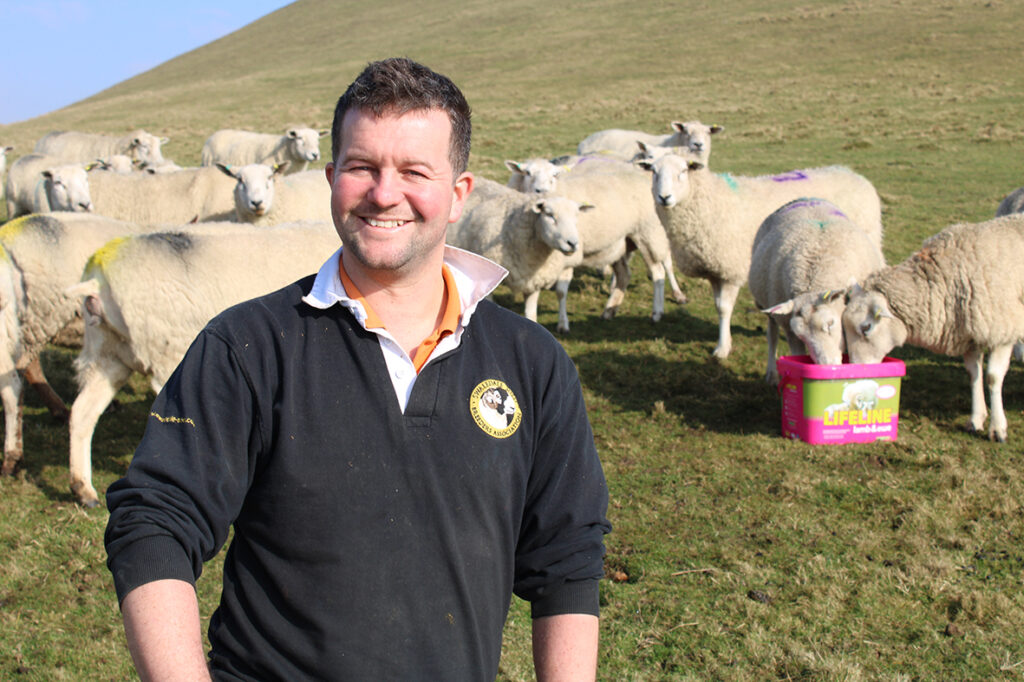
Extreme weather conditions in north Yorkshire over the last couple of years have impacted on the low input system at Tom Carlisle’s farm near Skipton. Diminishing soil nutrients and a lack of forage as a result of flood and drought conditions have cost the farm, but an emphasis on animal health and welfare has carried them through.
Coxons Farm extends to 420 acres of beautiful Yorkshire Dales land which Tom farms in partnership with his parents. However, for the Carlisle family, the land has its challenges, especially when it comes to providing the quality and quantity of forage needed for their flock of 620 Texel cross ewes and herd of 35 suckler cows.
“We are a traditional system and want to farm in harmony with nature, so we try to minimise the use of inputs and have found ways to incorporate sustainable practices that are supported by various SFIs. However, it is often difficult to qualify, and many of the schemes are niche so we are having to evaluate our system more than ever,” says Tom.
He suggests that with most of the farm sitting above a bed of limestone, the soil quality is not the best, and that recent soil tests have shown the full effect of the extreme weather conditions experienced in the north over the last couple of years.
“Flood, then drought, then more flooding has seen the soil leach significantly during the winter and also lock up nutrients in the summer. Without soil testing we wouldn’t have been aware of the deficiencies facing the flock. We have seen drops in potassium, calcium and selenium, along with very low levels of iodine and sodium,” he says.
Forage testing uncovered the full extent of the nutrient deficit and signalled further potential issues. Very high sodium and chloride levels were recorded and could be a potential cause of other nutrients being held back. Low magnesium, copper and zinc were also a concern, especially as the baled silage tested much higher than average for molybdenum. To offset the lack of nutrients available to grass, and a shortage of forage over winter, he has turned to supplementation to help.
“Never before has it been as important to maximise forage utilisation as in the last couple of years. We have found Rumevite a good way to help body condition over winter and we are big advocates of using Lifeline Lamb and Ewe in the six weeks leading up to lambing,” he says.
The farm started using the supplements on a small scale ten years ago and have since steadily increased the availability of supplements to the flock. In particular, LifeLine Lamb and Ewe has been an important addition, especially when the farm experiences cold and snowy conditions.
“We started by just feeding blocks but moved to the LifeLine buckets in a bigger way more recently. The recent pink bucket campaign, which raises money for the Pink Ribbon Appeal, was close to our hearts. However, from a strictly farming point of view, I have found that the flock performs much better with it,” he says.
2026 saw a somewhat predictable drop in the farm’s scanning result. Normally the flock will scan at 190, but this year has seen it drop to 176.
“We think the drought is the root cause. Maybe the ewes were too lean going into tupping. We will be keeping a closer eye on body condition this year and supplementing appropriately to provide the ewes with what they need,” he says.
 As lambing approaches for the farm, the ewes are in good condition and Tom suggests that another benefit of Lifeline is the effect it has on colostrum.
“We check colostrum every year and, in the years we have been using Lifeline, it has been better. Because we are lambing mostly outdoors it is so important that the ewes are carrying a ready supply for their lambs and that it is the best quality,” he says.
The farm lambs at a steady pace of roughly 120 sheep per week, which helps to stagger the resulting sales of lambs through the year to bring a more balanced income. It also gives the family time to wet mother-on orphan lambs to save the cost of milk replacers.
“We lamb most of the triplets inside, along with some singles, to help us mother-on as many as possible. We have fairly small fields so we start separating larger, fatter lambs early on and divide the flock into those needing additional feed and supplementation. The smallest are sometimes sold on as stores but most are finished to a good weight and we often use Rumevite blocks to achieve this,” he says.
The farm has been building a reputation for producing good quality breeding lambs by buying in better stock to improve the genetics.
“While we are a commercial farm by and large producing lambs for slaughter it is rewarding to see lambs going above and beyond for breeding purposes also. Conventional livestock farming is being squeezed from all sides. We diversified into glamping pods five years ago to future proof our farm and along with my social media presence as the @dalesfarmer, we now have a more robust and diverse business for the future,” he concludes.