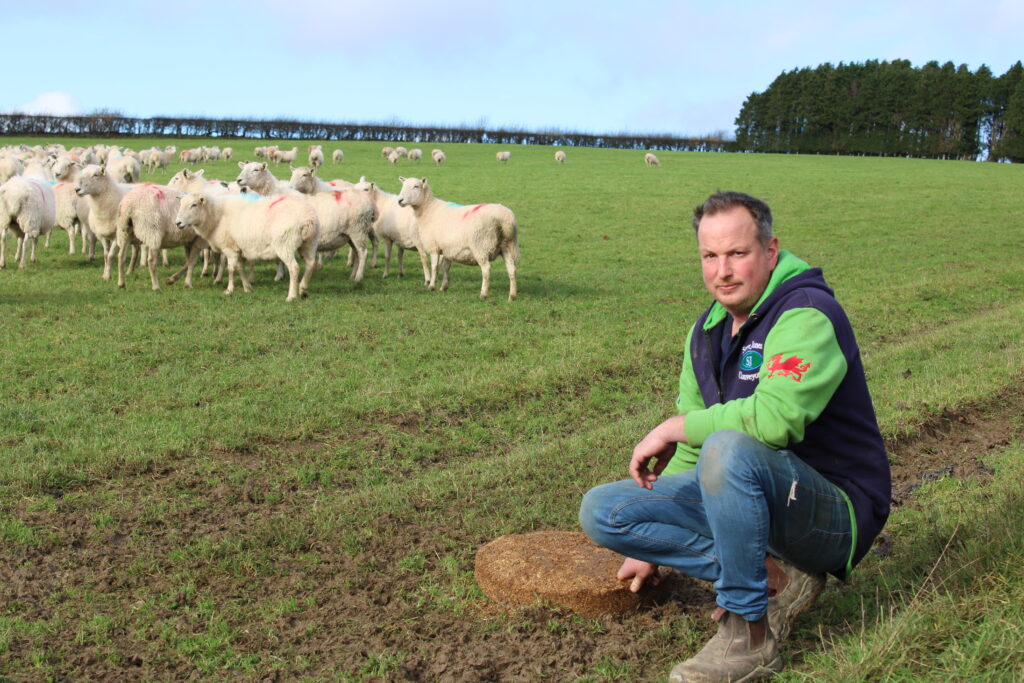
For Welsh sheep and beef farmers Eric and Steve Jones, forage quality and quantity are rarely an issue. However, the drought conditions faced in 2025 have caused them to supplement the flock earlier to maintain body condition.
Upper Lloyney Farm covers 350 acres of good grazing land near Newchurch Powys. Father and son, Eric and Steve also rent additional summer grazing land for their flock. A mix of Speckle Faced and Welsh Mules makes up the flock, which normally has access to ample forage for grazing and, in a normal year, the farm is able to make good hay and silage bales.
“We thought 2022 was a poor year, but 2025 has been equally poor. We started using Rumevite early this year to help the flock get more from the forage that was available, and it has saved the day,” explains Eric.
The flock is relatively late to the tup and lambs in late April to early May. With just one silage cut taken, there is a lot riding on grazing quality.
“Very rarely have we lost grass cover here, normally there is always a little bit of rain to keep the grass coming through, but this year some parts of the farm were yellow rather than green,” he says.
The farm reacted to the reduction in grass by planting forage rape and stubble turnips.
“Even though we planted in the drought, the alternative forage crops have grown remarkably well. It shows that there was moisture in the soil but the grass roots weren’t getting deep enough, and the relentless hot sunshine burnt the grass before the sheep could reach it,” he adds.
The aim is to have the flock on the rape and turnips until January, but Eric’s son Steve concedes that it is not rich enough and will only act as a ‘carrier, not a finisher’.
“It’s another reason we supplement, because the forage diet alone often isn’t enough, but we don’t want to spend too much on cake. Concentrate prices are high, up to £300 for ewe nuts and we will need to feed next year’s lambs more because of this year’s drought,” he says.
He would expect to use around 10-15 tonnes of Rumevite from November to January, but this year is expecting to use 16 or 17 tonnes.
“It’s about having something there for them all the time. Little and often works well for our flock and it keeps them going,” says Steve.
Maintaining ewe body condition is a concern for the farm, especially in a challenging forage year.
“The cost of replacements has gone up, and we would normally buy 300 to 350 a year because we cull fairly hard to keep a young and productive flock,” he says.
With such a challenging year for forage the farm is giving extra attention to body condition and ensuring the correct supplementation is used to keep ewes in the best health.
“Using Rumevite along with concentrate helps to maintain the body condition of the ewes all the way through to lambing, and this helps keep them strong for giving birth, producing colostrum and feeding newborn lambs,” he says.
With forage stocks down despite attempts to stimulate grass growth in spring and summer months, the farm will be almost devoid of baled forage and hay by the spring.
“It is going to be a difficult winter. We only took 7 bales to the acre this year compared to the 9 we would normally take. We used 45 kilos of N per acre of grazing land at the end of April but still didn’t get back the kind of forage we needed because of the drought. Thankfully, a little September rain meant that, when we applied the same amount again, we got a good autumn flush,” he says.
The farm soil tests every year after planting rape and turnips. Grazing ground is also tested and pH levels are taken every five years.
With margins tight, Steve has started a new enterprise to help create a second income. 10 years ago, he started SJ Conveyors by hand-building a motorised sheep conveyor. It was not originally intended to be a business, but word got around and now he is manufacturing around 50 conveyors a year, with the view to expanding in the future.
“It keeps the sheep’s feet off the ground so they can’t kick when we are giving them injections or a drench. We drenched 1285 in one hour this year and gave them all a vaccine at the same time. Dad did the vaccine, and I did the drench. I never expected to have a business making them, but, with the recent grants, many farms have seen them as a cost-effective investment which can save them a lot of time,” he says.
His entrepreneurship is commendable but it’s the circumstances the farm has found itself in that have led to it being necessary rather than a sideline.
“It’s getting harder to make a good living out of livestock. We are reliant on years of experience and luck to get us through from year to year, but, with droughts like this year, it shows us how vulnerable the farming system is and how expensive it could be if we weren’t making the right decisions to provide alternative forage and the correct supplementation the flock needs to thrive,” he concludes